



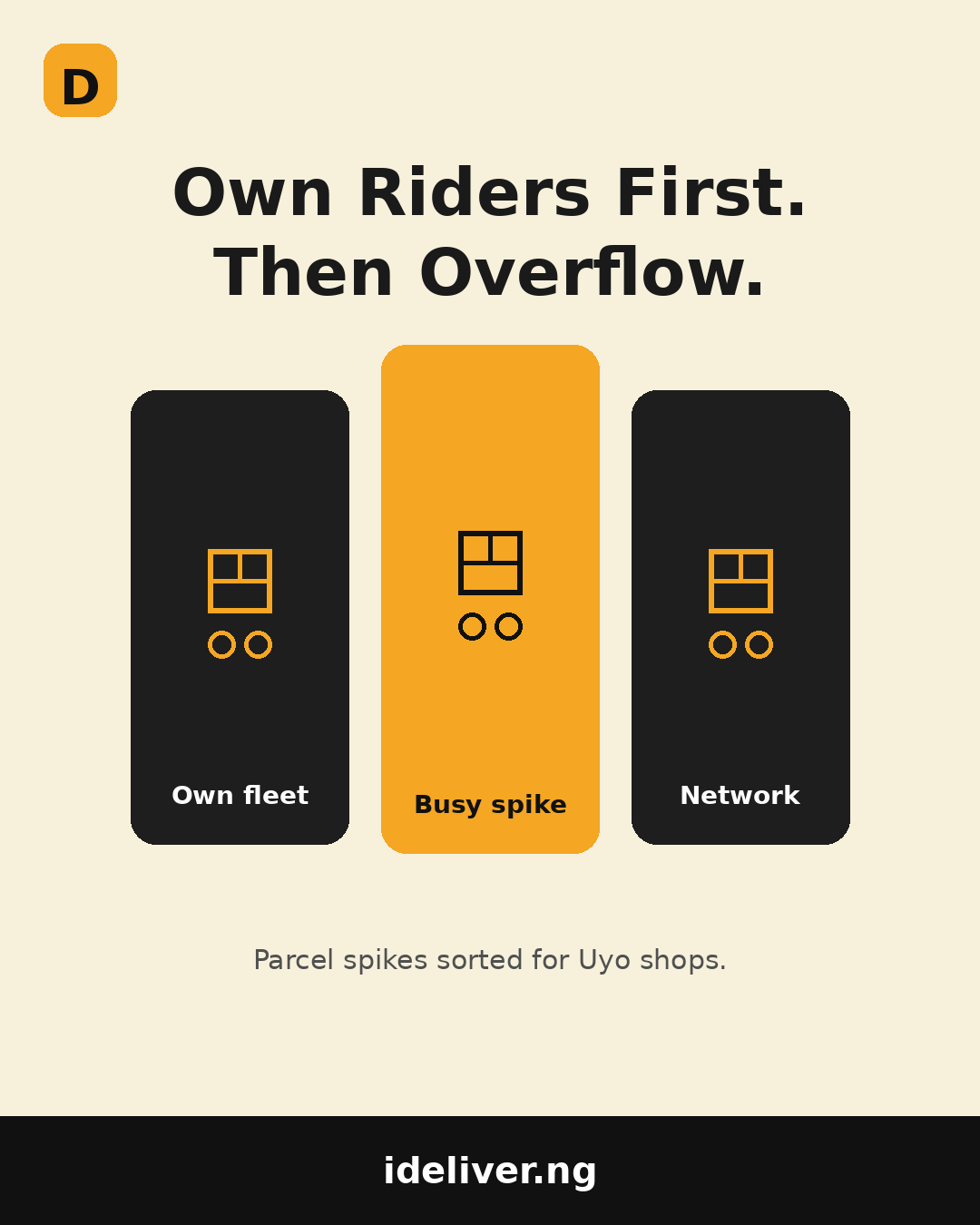






Some days the shop is quiet. Other days everything arrives at once — parcels for customers across town, a bulk order that needs a bigger vehicle, and your two trusted riders already on the road. That is a real Uyo hustle moment. Not a spreadsheet problem. A “who is free right now?” problem.
Thursday is Freight day on this blog, so we are talking parcels, spikes, and how businesses keep moving without building a full logistics company from scratch. The warm truth is simple: keep your own riders first, then borrow the network when you need overflow. That is how iDeliver’s merchant logistics is meant to feel. 📦
Own fleet first — the people who already know your streets
If you run a shop, pharmacy, bakery, gadget store, or e-commerce counter in Uyo, you already know your best riders. They know which gate to call. They know which street floods when the rain starts. They know how you pack fragile items.
That trust is an asset. So the smartest dispatch order is not “send everything to strangers.” It is:
- Use your own fleet for the jobs they can carry today.
- Overflow to vetted platform riders when your team is full, late, or suddenly slammed.
- See the split between internal fleet cost and outsourced cost, so your wallet story stays honest.
That mix is the heart of Merchant Route thinking on iDeliver. Your riders stay primary. The network is backup with muscles. Busy days stop feeling like a crisis and start feeling like a plan.
When the spike hits, overflow should be boring
Spikes are normal. Month-end. Market days. Rainy evenings when customers refuse to leave home. A viral product that suddenly sells. A church or office bulk order that lands at 3pm and needs to move before close of day.
In the old pattern, you call three people, send voice notes, promise a customer “we are coming,” and hope. In the better pattern, you create the delivery, the engine looks for the nearest available rider inside your dispatch setup, and the customer gets a tracking link they can actually use.
On iDeliver’s merchant side, that flow is meant to be practical:
- Create the order with pickup, drop-off, and customer phone.
- Let dispatch find a rider based on your zones and pricing.
- Charge the delivery fee from your pre-funded wallet at pickup.
- Send live updates as the parcel moves — including a public tracking page the customer can open.
WhatsApp and Telegram dispatch — logistics without leaving chat
Not every shop wants to live inside a developer console. Plenty of Uyo businesses already run their day on WhatsApp. That is why iDeliver also offers no-code merchant channels:
- WhatsApp AI Agent for merchants who want to dispatch from the chat they already use.
- Telegram bot (@iDeliverfastbot) for quotes, dispatch, wallet checks, and recent history.
On Telegram, for example, you can ask for a fare with /quote before you promise a customer anything. You can check /balance, look at today’s summary, and track the last order without opening a laptop. The bot is linked from the merchant dashboard after you connect it under settings.
If you prefer the dashboard, use it. If your storefront is WooCommerce, plug into that path. If you have a developer, use the REST API with sandbox keys first. Same network idea underneath: create the delivery, dispatch a rider, track it, settle from wallet.
Pick the right vehicle for the parcel (not just “send okada”)
Freight is not only small envelopes. Some days it is a cake box. Some days it is cartons. Some days it is something fragile that should not bounce on a rough stretch of road.
iDeliver’s logistics side thinks in vehicle types for a reason:
- Motorcycle — the everyday default for lighter parcels (think the usual small-to-medium package).
- Bicycle — short, light hops when that fits.
- Car — fragile items or heavier loads up to the car class.
- Van — bulk that needs more space.
- Truck — the heavy jobs beyond van territory.
You can hint the vehicle you need, or include weight and size details so the system can suggest a sensible option. The point for a shop owner is practical: stop forcing every package onto the same bike just because that is what you called last week. Match the load. Protect the item. Protect the rider’s time too.
And before you create the order, coverage and fare preview matter. Quote first when you can. Confirm the destination is in range. Then dispatch. That is how you avoid awkward “we cannot reach there” conversations after the customer has already paid you for the item.
COD, wallet honesty, and trust the customer can see
Parcels in Nigerian cities often carry two kinds of trust: money and location. Cash on delivery is supported on the merchant logistics path when you need it. Your wallet still needs to be funded for delivery fees — top up before the busy window, not after riders are waiting.
Wallet honesty is part of the culture here: you see what your own fleet costs versus what overflow costs. You are not guessing where the money went after a loud weekend.
For the customer, trust looks like a tracking link that updates. They stop calling every ten minutes. You stop narrating the journey from memory. The rider focuses on the road. Everyone breathes a little easier.
That is the freight win that actually feels local: fewer mysteries, clearer handoffs, and a shop that can say yes to more orders without burning out its small rider team.
Make Thursday’s parcels feel like a system
If your shop has been surviving on calls and goodwill, try one cleaner Thursday habit:
- Morning: Top up the merchant wallet and confirm your default pickup address.
- Before promises: Use a quote (dashboard, Telegram /quote, or your integration) when a customer asks “how much to deliver?”
- At spike time: Own riders first. Overflow when they are full.
- At handoff: Let tracking do the talking so you can keep selling.
That is the iDeliver merchant story on Freight day — parcels, vans when needed, own fleet plus overflow, WhatsApp/Telegram when you want chat-speed dispatch, and a customer who can follow the package without stress.
Open the merchant dashboard and set your dispatch up properly: https://merchant.ideliver.ng. Keep your riders close. Borrow the network when the counter gets loud. Your city still moves. 🛵



What do you think?
It is nice to know your opinion. Leave a comment.